In my March 22, 2024 post I wrote about my family's love of history
and about visiting two powerful military sites during the previous twelve months.
I saw the sites as historical bookends,
linking the beginning and end of defensive coastal fortifications and artilleries.
I didn't name the strategic sites, but indicated that I would write about them shortly.

My Dad, the History Major, at Acadia
Acadia University, Wolfville, Nova Scotia, Canada
Circa 1947
© M. Louise (MacBeath) Barbour/Fundy Blue
All Rights Reserved
When my original post was published it was flagged
with a warning for containing sensitive material.
To say I was shocked is an understatement.
I went over and over the post, but I couldn't figure out what was objectionable.
I tried to contact Google to find out what happened,
but I hit a wall and couldn't access any help. I gave up.

My Mom, Who Encouraged my Love of Reading About Everything
Acadia University, Wolfville, Nova Scotia, Canada
1947
© M. Louise (MacBeath) Barbour/Fundy Blue All Rights Reserved
So, I'm going to go back to the topic, and I will see what happens.
Fingers crossed, for sure!
In both instances world powers were struggling for control of a strategic site
that was a gateway to resources, trade, commerce, and empire.

A Strategic Site Overlooking San Juan Bay
San Juan, Puerto Rico
April 15, 2023
© M. Louise (MacBeath) Barbour/Fundy Blue All Rights Reserved
Castillo San Felipe del Morro, or El Morro as it is commonly referred to, is the first site.
What began in 1539 as a tower and three cannons
on a promontory overlooking the entrance to San Juan Bay
became over the next 250 years a mighty six-level fortress
incorporating the highest military standards and technology of its time.

El Morro is considered the oldest Spanish fort in the New World.
Spain held El Morro for 359 years until the US gained
control of it in 1898 during the Spanish American War.
It remained an active US military installation during the first and second world wars.
The US Army retired El Morro in 1961 and turned it over to the National Park Service.
The United Nations declared the fortress and walled city of Old San Juan
UNESCO World Heritage Sites in 1983.

Three UNESCO sites protecting San Juan and Puerto Rico:
Fortín San Juan de la Cruz (El Cañuelo - "Small Channel")
Castillo San Felipe del Morro
Castillo de San Cristóbal
April 14, 2023
© M. Louise (MacBeath) Barbour/Fundy Blue. All Rights Reserved

Overlooking the Entrance to San Juan Bay and Fortín San Juan de la Cruz from El Morro
Crossfire between El Morro and Fortín San Juan de la Cruz
protected San Juan Bay and the interior of Puerto Rico from invaders.
April 15, 2023
© M. Louise (MacBeath) Barbour/Fundy Blue. All Rights Reserved
It's one thing to look at the fortress in photographs, drawings, and maps.
It's quite another to wander through the Field of Fire where so many died,
and to touch the walls and walk the floors of the fortress.
You can feel the history and emotions of centuries
emanating from the grounds and stones surrounding you.

Field of Fire, or Esplanade, at Castillo San Felipe del Morro
San Juan, Puerto, USA
April 15, 2023
© M. Louise (MacBeath) Barbour/Fundy Blue All Rights Reserved
Historically an esplanade was a large, open area outside a fortress.
It provided clear "fields of fire" for the fortress's guns.
Today the Esplanade is a place where locals come to relax, picnic, and fly kites.

Locals Enjoying a Beautiful Morning on the Esplanade
San Juan, Puerto, USA
April 15, 2023
© M. Louise (MacBeath) Barbour/Fundy Blue. All Rights Reserved
The massive fortress was designed to repel attacks by sea,
and over the centuries it successfully blocked every naval assault,
including three British attacks in 1595, 1598, and 1797 and one Dutch in 1625.
During the Spanish-Cuban-American War of 1898, El Morro saw action for the last time.
After the U.S. occupied Puerto Rico in 1898,
control of all the Spanish-era fortresses passed to the U.S. Army.
To enter El Morro today, you cross over a concrete bridge above the dry moat.
In colonial times the bridge was a drawbridge protecting the eastern side of the fortress.
The dry moat had two purposes, to protect the base of the fort from enemy cannon fire
and to force enemy soldiers to descend before before trying to scale the fortress walls.

The Concrete Bridge and Dry Moat at El Morro

The Entrance to El Morro
April 15, 2023
© M. Louise (MacBeath) Barbour/Fundy Blue All Rights Reserved
To the right of the entrance is the El Morro Lighthouse.
Puerto Rico's first lighthouse was built at El Morro in 1846.
The current lighthouse was built by the U.S. Coast Guard in 1908.
It is only 51 feet high, but it sits on the sixth level of El Morro
giving it another 140 feet in height.
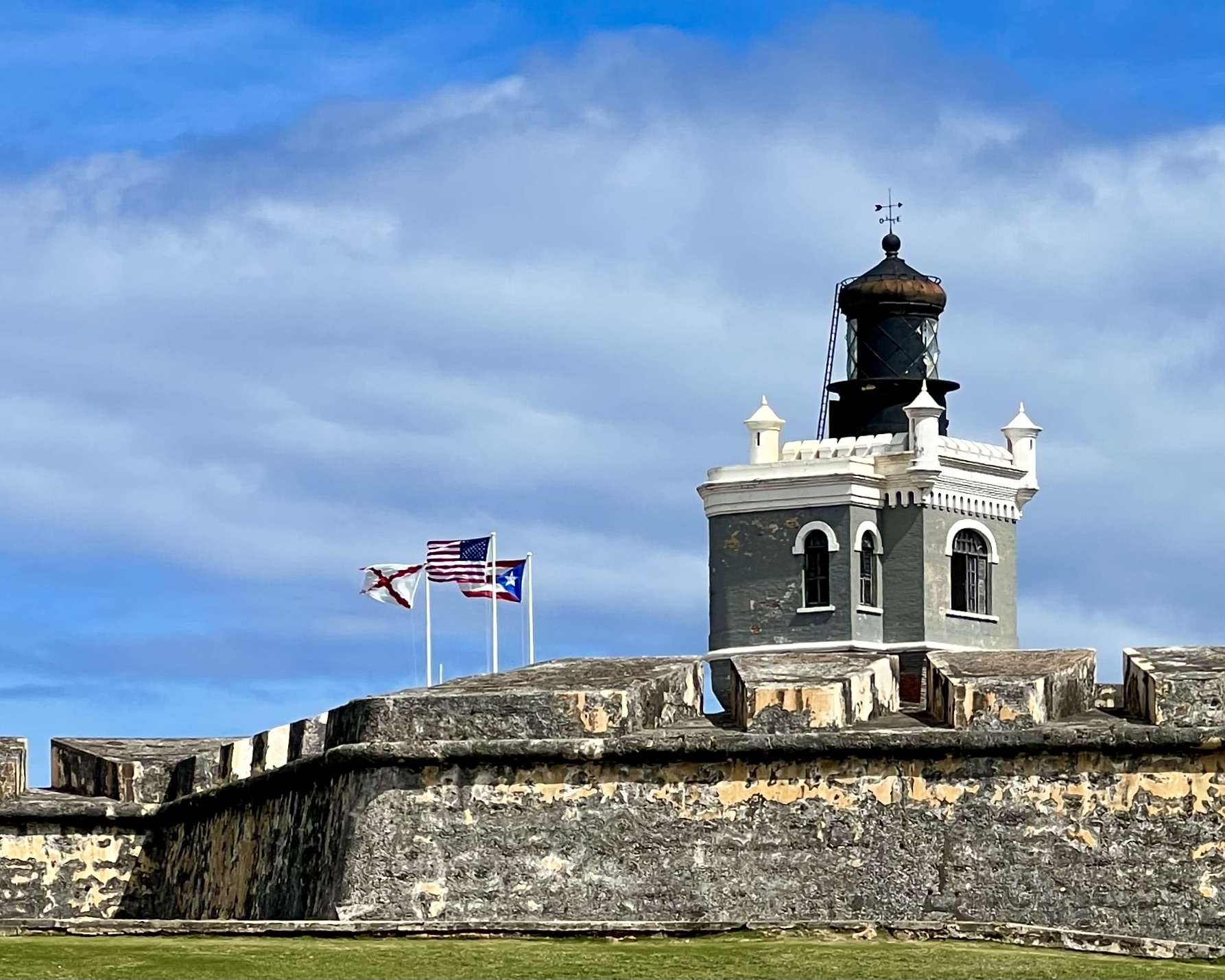
The El Morro Lighthouse Located on the Ochoa Bastion
April 15, 2023
© M. Louise (MacBeath) Barbour/Fundy Blue All Rights Reserved
When you pass through the entrance, you enter The Plaza de Armas
or Main Plaza on the Fifth Level of El Morro.
Today the main plaza looks very much like it did when it was completed around 1780.
Here troops drilled and assembled for formal occasions.
Around the plaza are arched casements, large vaulted rooms that contained
a kitchen, chapel, storage areas, officers’ quarters, and barracks for enlisted men.

The Plaza de Armas or Main Plaza of El Morro
April 15, 2023
© M. Louise (MacBeath) Barbour/Fundy Blue. All Rights Reserved

The Plaza de Armas or Main Plaza of El Morro
Information Sign
April 15, 2023
© M. Louise (MacBeath) Barbour/Fundy Blue All Rights Reserved

Capilla de Nuestra Señora de los Navegantes
(Chapel of Our Lady of the Navigators)
This small chapel occupies one of the casements in the main plaza of El Morro.
The arch in a casement provided strength to support gun decks above it
and protection from the concussion of exploding shells.
April 15, 2023
© M. Louise (MacBeath) Barbour/Fundy Blue. All Rights Reserved

The Plaza de Armas or Main Plaza on the Fifth Level of El Morro
Here you can see the wellhead where soldiers drew water from three large cisterns under the plaza.
April 15, 2023
© M. Louise (MacBeath) Barbour/Fundy Blue All Rights Reserved
By the early 1500s, Spain had already conquered what are now Mexico and Peru.
These lands had abundant gold, other precious metals, and gems
which the Spanish plundered and mined.
They sent these treasures back to Spain on galleons.

In order to protect these ships from the English, French and Dutch,
Spain began fortifying important ports along the sea routes.
Because San Juan was the first port encountered by ships entering the Caribbean,
the Spanish Crown recognized that it needed to be fortified.
Initially El Morro consisted of a masonry tower and a water battery with three cannons.
The gunners quickly discovered that the noise and smoke
from firing cannons inside the tower was too much to bear.
Thus began a learning process that spanned centuries.
After attacks and discoveries of weaknesses,
El Morro would expand and improve its defensives.
King Philip II ordered the addition of a hornwork and two half-bastions connected by a curtain wall to protect the landward approach to the original tower,
as well as a moat to give more height to the walls and a drawbridge.
The work was completed in 1595.

El Morro in 1891
The curtain, or defensive wall, joins two half bastions on the landward approach to the original tower.
The tower is the circle in the lower left.
Today the bastions are known as the Ochoa Bastion (upper left) and the Austria Bastion (upper right).
They form the sixth level of the fortress that rises over visitors as they approach the entrance to El Morro.
wikipedia (image modified by me ~ see site for license)

Here you can see the "horns" of the half bastions protecting the entrance to El Morro:
also the dry moat, the cement bridge spanning the moat,
and the bastions and curtain wall of the sixth level (gray)
and the main plaza of the fifth level (orange).

Terry Explores the Bacteria del Carmen on the Fifth Level of El Morro
April 15, 2023
© M. Louise (MacBeath) Barbour/Fundy Blue. All Rights Reserved

The El Morro Lighthouse on Level Six of El Morro
April 15, 2023
© M. Louise (MacBeath) Barbour/Fundy Blue All Rights Reserved

The Three Flags Flown at El Morro Today
The Cross of Burgundy ~ The Old Spanish Military Flag Which Was Flown at El Morro from 1539-1785
The United States Flag and the Puerto Rican Flag
April 15, 2023
© M. Louise (MacBeath) Barbour/Fundy Blue All Rights Reserved

Terry Enjoys The View of Old San Juan
from Level Six of El Morro
April 15, 2023
© M. Louise (MacBeath) Barbour/Fundy Blue All Rights Reserved

Cannons on the Main Firing Battery
Level Four of El Morro
April 15, 2023
© M. Louise (MacBeath) Barbour/Fundy Blue All Rights Reserved
The Spanish completed El Morro in 1790.
Their latest improvements to the fortress included
3 cisterns under the main plaza that held 216,000 gallons of water
and walls strengthened to 18-40 feet thick.
The main Santa Barbara Battery had 37 cannons
backed by casement guns at higher and lower levels.

Terry Emerges from a Garita or Sentry Box
Level Four of El Morro
April 15, 2023
© M. Louise (MacBeath) Barbour/Fundy Blue All Rights Reserved

The Main Artillery Ramp and Stairs at El Morro
Leading to the Main Battery on Level 4
Soldiers raised and lowered 5-ton cannons on this ramp.
April 15, 2023
© M. Louise (MacBeath) Barbour/Fundy Blue All Rights Reserved

The Main Artillery Ramp, Guard House, and Walls
Main Battery on Level 4
April 15, 2023
© M. Louise (MacBeath) Barbour/Fundy Blue All Rights Reserved
Terry's and my visit to El Morro was far too short.
We scrambled to see what we could in less than an hour.
I would love to return to this formidable fortress and spend more time here.
The second strategic site lies on a different side of the Americas and in another ocean.
World War II demonstrated that the time for defensive coastal fortifications
and artilleries had passed. They were no longer effective in modern warfare.
I'm linking to Rain's Thursday Art and Dinner Date, Tom's Aloha Friday, and Nicole's Friday Face Off.
For Rain: Vincent Van Gogh ~
I know I have a photo of Vincent van Gogh's Sunflowers from the National Gallery in London, but I can't find it.
.jpg)
Sunflowers by Vincent van Gogh 1888
National Gallery
London, United Kingdom

Sunflowers
Victoria, British Columbia, Canada
September 12, 2017
© M. Louise (MacBeath) Barbour/Fundy Blue All Rights Reserved
Opps! These Are Coneflowers!

Sunflower and Bee
Butchart Gardens
Brentwood Bay, British Columbia, Canada
September 12, 2017
© M. Louise (MacBeath) Barbour/Fundy Blue All Rights Reserved
For Tom: Aloha ~ A Hawaiian Sunflower!

Yellow Hibiscus
Honolulu, O'ahu, Hawai'i
January 27, 2024
© M. Louise (MacBeath) Barbour/Fundy Blue. All Rights Reserved
For Nicole: Curiosity ~
I could find Terry in the National Gallery, but not Vincent.

Terry Views a Lion-Headed Dagger
India, Mughal Dynasty 1650-1700
The National Gallery, London, United Kingdom
September 3, 2015
© M. Louise (MacBeath) Barbour/Fundy Blue. All Rights Reserved
Have a great weekend!

Till next time ~
Fundy Blue
My next post will be
Wednesday, May 31st. 🤞
On the Bay of Fundy
© M. Louise (MacBeath) Barbour/Fundy Blue
All Rights Reserved


.jpg)

