Curiosity prompted my father
to apply for a teaching position
he saw advertised in the summer of 1960.
The thought of teaching Indian children
at a Church of England Day School
in Lansdowne House on Lake Attawapiskat
had an aura of adventure about it.

At first, even finding a map that showed
the remote village deep in the boreal forest
of northern Ontario proved impossible.
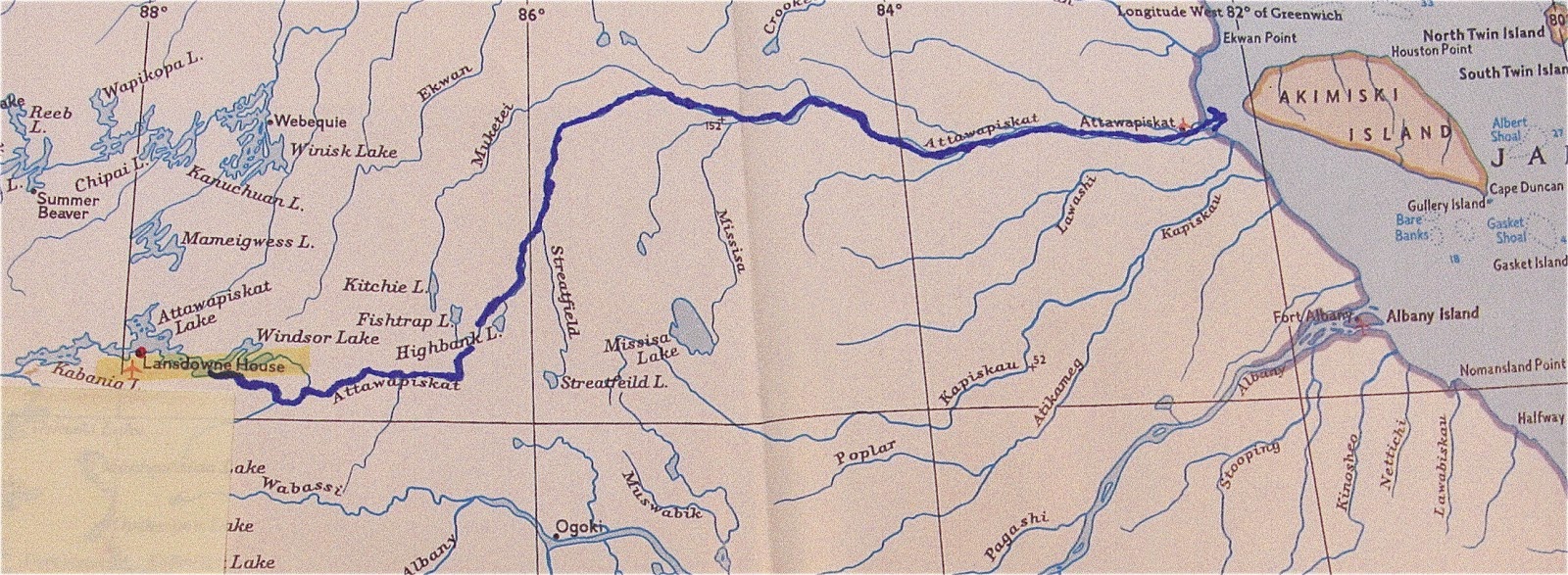
Location of Lansdowne House
Sketch Based on Map of Ontario from
Atlas of North America:
Space Age Portrait of a Continent
National Geographic 1985, pages 166-167.
My father said of his quick job offer:
"I was accepted almost instantaneously,
and although I like to think that this
was because of my qualifications,
I imagine my speedy acceptance
by the Indian Affairs Branch
was largely attributable to the fact
that at that particular time,
the Branch was desperate for teachers."

Circa 1950
© M. Louise (MacBeath) Barbour/Fundy Blue
All Rights Reserved
The fact is that it was difficult
for the Indian Affairs Branch
to lure teachers into the isolated north.
Enticements included
a generous paycheck,
an isolation allowance,
and a furnished teacherage
with heat and light supplied for
between $40.00 and $60.00 a month.

Department of Transport Housing
Lansdowne House
A Teacherage Would Be Something Like This
Photo by Don MacBeath, Fall of 1960
© M. Louise (MacBeath) Barbour/Fundy Blue
All Rights Reserved
The Indian Affairs Branch glossed over a few details:
1. There was nowhere to spend that excellent remuneration.
2. Heating oil was hauled in 45-gallon drums
over the frozen landscape and into the
northern villages by tractor train once a year.
(To see historical tractor train (cat train) photos click here)
The teacher (or his ten year old daughter)
had to go outside to the fuel drum and
hand pump the oil into a portable container
to carry the fuel inside and pour it into the furnace.
This was the most fun on dark -50º F nights,
with the Indian dogs howling nearby.
3. Electric lights and power were provided
by small Delco diesel generators
with the diesel fuel hauled in
by the same tractor trains.
Unless, of course, there was no generator,
and the teacher had to light his home
with volatile kerosene lamps.

Modern Fuel Drums
(The drums 50 years ago looked just like these ~ minus the labels.)
Unfortunately for my father,
the Anglican teacherage in Lansdowne
had burned down the year before.
There was no place for our family to live.
Dad loved the North,
but more than anything,
he wanted us to join him.
Mr. Foss, the Indian Schools Inspector
assured my father at his orientation
in Sault Ste. Marie that a new teacherage
would be available for the 1961-62 school year.
Construction would take place
in the summer of 1961,
once the building materials
were hauled in by the tractor trains
in the winter of 1960-61.

A Tractor Train
(also called Cat Train)
This train is carrying an actual house, not building materials.
Dad kept trying to find out more
about the planned teacherage
from the government official
he saw most frequently,
the Nakina Indian Agent Gowan.
I'm sure my father's frustrating experiences
trying to procure desks for his students
did not encourage positive thoughts
about the new teacherage.
On Friday, October 7, 1960
my father wrote to his mother about housing
and educating his own children:
... The new teacherage
that they are planning to build
will be very nice from all the reports.
However, I just wrote a letter to Foss
about the size of the building.
From what I can learn from Mr. Gowan,
it will be pretty small for my family.
Mr. Gowan wasn’t too sympathetic though.
He said that they were hiring
a teacher and not his family.
This is a rather stupid attitude I think,
for I certainly won’t stay here
if I don’t get a decent place to live.
I would be willing to stay for several years
if they provided an adequate house,
and I would think that it would be better for the Indians
if they could have a teacher stay for a while,
instead of having a new one every year.
Besides, they ought to be glad to get a teacher
with my qualifications and experience
who is willing to stay in an isolated place like this.
I pointed all this out to Foss when I wrote to him.
As far as the children’s’ education is concerned,
I don’t foresee too much trouble.
If all else fails, we can educate them using the
Ontario Department of Education Correspondence Courses.
After all, I am a teacher by profession,
and I like to think that I am a fairly good one,
enough to teach my own children if I have to.
Bye now, love, Don.
FB Notes:
1. The rest of this letter was shared in last week's northern post.
2. The You Tube video below shows a modern cat train (or tractor train as we called them in
Lansdowne House). It may help you imagine what a tractor train was like 50 years ago.
3. You would not believe the shenanigans I went through to find and post this video!

Till next time ~
Fundy Blue