Friday, April 6, 2018

The Lansdowne Letters: The Delousings


I wouldn't be sharing my family stories today
were it not for my paternal grandmother,
Myrtle Pratt MacBeath.

When my father began writing his Lansdowne Letters,
he asked his mother to save them.

© M. Louise (MacBeath) Barbour/Fundy Blue
All Rights Reserved


Sometimes she and my father would agree to burn
very personal letters they had written to each other,
but most of my father’s letters survived,
thanks to Nana’s efforts to preserve them.

My mother wrote frequent letters too,
but only a few of hers have survived,
also due to her mother-in-law’s effort.

I imagine that many of the letters my mother wrote to her mother
went up in flames in the trash barrel in her mother’s backyard.
My maternal grandmother, Ella Cossaboom MacDonald,
believed that many things should be consigned to the flames,
perhaps because her family history contained dark secrets.


My Grandfather Jack Courting My Grandmother Ella
Circa 1913
Smith's Cove, Nova Scotia, Canada
© M. Louise (MacBeath) Barbour/Fundy Blue
All Rights Reserved


I can still see Grammie in all kinds of weather feeding the flames
in her trash barrel near the old apple tree that we used to swing from.


The Best Swing Ever!
Barbie swings while Donnie watches.
Fall, 1960
Smith's Cove, Nova Scotia, Canada
© M. Louise (MacBeath) Barbour/Fundy Blue
All Rights Reserved


The surviving Northern letters eventually found their way to me,
and I am grateful that Nana saved this letter written by my mother,
not just for the details of our days in the North,
but because it reminds me of what a rock she was for our family.
No matter what storm waves slammed her, my mother stood firm.

When the Indian Agent unexpectedly summoned my father
via radio to Nakina on the departing mail plane, 
he refused to tell my father the reason for the sudden trip.

My parents assumed the worse,
that another of my father's letters about the poor Indians
in Lansdowne House had hit the Canadian press
(Thanks to me and my Junior Red Cross project).

They thought he was about to lose his job.
They had no idea that Mr. Gowan would send Dad
on the overnight train from Nakina to North Bay,
again with no explanation.

No one would guess from reading this letter
that my mother spent four anxious days waiting for my father 
to fly back to Lansdowne House and tell her what was going on.
My parents had gambled everything on moving North,
and it would have been a disaster for my father to lose his job.

My mother stood firm.
She carried on with no idea when Dad would return,
even teaching school for him while he was absent.
There is no one I admire more than my steadfast mother.

She was the rock on which we rode out many storms,
sheltered by her love and her belief that everything would work out.  


On Thursday, June 1, 1961
My mother wrote to her mother-in-law,
Myrtle MacBeath:

Dear Mother:
I haven't gotten a line off to you recently.

© M. Louise (MacBeath) Barbour/Fundy Blue
All Rights Reserved


It was a madhouse here lately getting ready for break-up,
and then Don leaving unexpectedly for North Bay.

I taught school for him all day Monday,
washed all day Saturday at the nursing station,
and on Sunday I had Sunday school for the children
and started out for a wiener roast with them,
but had to come back for the wind was too cold.
We had our picnic in the house.
They all seemed to enjoy it anyway.


Sunday morning bright and early
Roy opened his gifts from you.

He and Louise are both reading the book you sent.

The shirt and socks are lovely.
The children were all delighted
with the candy, tablets, and pens.

© M. Louise (MacBeath) Barbour/Fundy Blue
All Rights Reserved


Don got word Friday morning that he was leaving that day.
We were having a party in the afternoon for Roy, Glennie, and Duncan Jr.
Their birthdays were on the 26th and Roy’s on the 28th,
so we decided to celebrate them all at the same time.

I made Roy a birthday cake, an angel cake,
and I added walnuts and cherries to it and decorated it
with white icing and little round colored candies.
It looked very nice.

Roy received two t-shirts, a silk Hawaiian shirt,
a water pistol, and a cap pistol (from Louise).
Don gave him a pair of fins and a snorkel outfit
when he came back from North Bay.
All in all Roy had a very nice birthday.

The weather has been very beautiful.
The lake is so much prettier without the ice.
We went on a picnic the Sunday before last
up the lake in the canoe and took along a camp stove.
We had a lovely time.
It was difficult to keep the children out of the water,
and it was still freezing cold.


Lake Attawapiskat
The Paths to Our Water Hole
After Breakup, 1961
Lansdowne House, Northern Ontario, Canada
© M. Louise (MacBeath) Barbour/Fundy Blue
All Rights Reserved


Roberta goes to play with Glennie and Duncan in the mornings
quite frequently.  It is the only solution to our problem,
for they have a fence all around the yard which is big. 
They play in a sandbox and have a great time covering each other with sand.

We are all excited about going to Sioux Lookout;
and, of course, Don is looking forward to his new job.
It will be good to have a bath tub again,
also a dentist, for I think Mike pulled the wrong tooth.
This isn’t Mike’s fault because he isn’t a dentist and pulled the one I indicated.

A lot of the Indian children had fleas, or is it lice, the kind Louise got in Atholville.
Our children and about two Indians didn’t have any,
but Mike had to spray ours today for fear
the Indians might think they were being discriminated against.


Donnie, Louise (me), and Roy
on the Stairs to Our Second Floor Apartment
Spring, 1957
Atholville, New Brunswick, Canada
© M. Louise (MacBeath) Barbour/Fundy Blue
All Rights Reserved


Except for Don’s trip, this week has been very quiet.
Father Ouimet and Brother Bernier were to come over for Bridge
on Tuesday evening, but the Father cut his hand badly on a planer.
He removed nearly half of one finger, and so he couldn’t come.
Mr. Pratt came with the Brother, and the Brother and I beat them,
but not by much.  Most of our games seem to be close here.

Thanks for the nice things you sent Roy.
He will be getting you a letter off this week.

I must get some more letters off, and it is very late,
so I will close for now.
I hope you and Aunt Maude are both well.
It must be a relief not to have to worry about the apartment house any more.
The children were all anxious about your garden.

With love,
Sara


The Tip of the Peninsula (Mainland)
A Pontoon Plane at the Hudson's Bay Dock
Fall, 1960
Lansdowne House, Ontario, Canada
© M. Louise (MacBeath) Barbour/Fundy Blue
All Rights Reserved


Lice!  If you've ever had them, you will never forget
the shame, the itching, and the remedy.

My teacher discovered lice crawling through my hair 
during a head check in the fall of 1957.

We had recently moved to the small Acadian village
of Atholville in Northern New Brunswick
where I attended a Roman Catholic school.
One of my teacher's periodic duties
was to check every student's head for lice.
I was mortified when she found lice on mine.

My teacher was almost gleeful because she didn't like me.
I was Baptist and likely the only Protestant student in the school.
The principal notified my mother and quickly sent me home.

Worse than the shame were the intense itching
and the nightmarish thought of bloodsucking insects
creeping among the roots of my hair
and attaching their pale nits to the base of individual strands.

Before bedtime each night, my mother washed my hair and dried it vigorously.
Then she sprinkled my hair with a DDT powder, rubbed it into my scalp,
and began the time-consuming task of combing my hair
with a fine-toothed comb designed to comb out lice and eggs.

I remember sitting in the lamplight in the kitchen, my head over an enamel basin
as my mother repeatedly parted my hair, side to side and front to back, 
and meticulously combed each section of my hair.

She frequently rinsed the comb under the hot water tap,
dried it, and sprinkled more DDT powder on it.

She combed and combed for a long time,
until she couldn't find any more lice or nits.
They were almost microscopic in size,
but they looked huge and disgusting to me.

Every morning she combed my hair again and washed my bedding.
This went on for a good two weeks.

At least I wasn't alone in my humiliation.
My teacher routinely found someone with lice.


Imagine how shocked I was when I walked into my school
that first Thursday afternoon in June, 1961,
and my father grabbed me from behind in a big bear hug.
The nurse, Mike O'Flaherty, dusted my hair with DDT powder,
and Dad tousled it with gusto.
I can still hear my father's gleeful chortle and my classmates laughing.

When Mike and my father discussed treating
the Ojibwa children for lice, they decided
to include my brother, sisters, and me in the process.
They did not want the Ojibwa children
to feel discriminated against because they were Indians,
so they hatched a plan to ambush me
and make the delousing more of a game.

They treated my dubious brother, 
and everyone giggled at our grey hair.
Soon there were greyheads everywhere,
and clouds of dust filled the air
as the children rubbed their heads and shook their hair.

My father chased us all outside for an early recess,
opened the school doors to air out the classroom,
and joined Mike for a quick cup of coffee
in the nursing station across from the schoolyard.

My mother may be the person I admire the most,
but my father wasn't far behind.


Till next time ~
Fundy Blue


On the Shore of the Annapolis Basin
Smith's Cove, Nova Scotia, Canada
July 24, 2016
© M. Louise (MacBeath) Barbour/Fundy Blue
All Rights Reserved


Notes:  

1.  The Problem with Bertie:
     Bertie was late learning to walk; but once she found her legs, she was always on the go.
     Bertie loved to play outside in Lansdowne House; and by the spring, she could slip out the kitchen
     door when my mother's back was turned.  One morning my mother opened the door after
     hearing a knock to find a wet and muddy Bertie riding on the shoulders of an Ojibwa neighbor.
     He had found her sitting in a puddle on a path in the bush singing and washing her dolly.  When
     the MacMahons invited Bertie to play in their fenced in yard, it solved a big worry for my parents.


For Map Lovers Like Me:
Location of Lansdowne House
Northern Ontario, Canada


Location of Atholville and Smith's Cove
Canada
Google Maps  Map Data 2018


Location of Atholville
New Brunswick, Canada
Google Maps  Map Data 2018


Atholville and Sugarloaf
As seen across the Restigouche River from Quebec, 2007
Wikimedia ~ Credit:  Tourisme-Nouveau-Brunswick


Wednesday, April 4, 2018

IWSG: Wednesday, April 4, 2018 ~ Back to Reality


It's the first Wednesday of the month:
the day when members of the
Insecure Writer's Support Group
share their writing struggles
and writing successes
and offer their encouragement
and support to fellow writers.


To visit the IWSG website, click here.

To become a member of the IWSG, click here.

Our wonderful co-hosts who are volunteering today,
along with IWSG founder Alex Cavanaugh are:
Olga Godim,  Chemist Ken  Renee Scattergood, and Tamara Narayan.  

I hope you have a chance to visit today's hosts and thank them for co-hosting.
I'm sure they would appreciate a visit and an encouraging comment.

~~~~~~~~~~~~~~~~~~~~~~~~~~~~~~~~~~~~~~~~~~~~~~~~~~

Every month the IWSG poses a question
that members can answer with advice, insight,
a personal experience, or a story in their IWSG posts.

Or, the question can inspire members
if they aren't sure what to write about on IWSG Day.

Remember the question is optional.
This month's featured question is:

When your writing life is a bit cloudy or filled with rain, what do you do to dig down and keep on writing?


~~~~~~~~~~~~~~~~~~~~~~~~~~~~~~~~~~~~~~~~~~~~~~~~~~

This month's question is uncomfortable.
I struggle with distractibility at the best of times.

I'm a bushy-tailed woodrat,
and I've spent my life scurrying from one enticing thing to another,
dropping one shiny object for the next sparkly item.

And Honolulu has a whole lot of sparkle!
I wrote well in February,
but somewhere along my glitter trail in March,
writing fell by the wayside.


Distractions ~ Diamond Head Lighthouse
from the top of Diamond Head Crater
March 10 2018
Honolulu, Hawaii, USA
© M. Louise (MacBeath) Barbour/Fundy Blue
All Rights Reserved


Irresistable ~ A Dilophosaurus
Expedition Dinosaur at the Bishop Museum
March 3, 2018
Honolulu, Hawaii, USA
© M. Louise (MacBeath) Barbour/Fundy Blue
All Rights Reserved


Now I'm back home and back to reality:
emptying suitcases, doing laundry, restocking the larder, 
and settling back into writing.

Honolulu, with its beauty and cultural richness, is behind me;
and I have to wait until next March 
to see the special friends I've made there,
both locals and snowbirds like me 
who return each year from around the world. 


Monday Night Kanikapila
at the Royal Grove Hotel
March 26, 2018
Honolulu, Hawaii, USA
Thanks Carolyn or Marianne for the photo!


The Jet Plane I Didn't Want to Leave On
Honolulu International Airport
March 27, 2018
Honolulu, Hawaii, USA
© M. Louise (MacBeath) Barbour/Fundy Blue
All Rights Reserved


As I confront reality, I have to admit to myself
that I am inconsistent at digging down and keeping on writing.
I'm binge and bust, and I'm getting tired of it.

Last IWSG Day, Michelle Wallace wrote about her #100words100 days challenge.
Her post has stuck in my mind ever since,
like glitter glue in my bushy woodrat tail.

I've decided to set the same goal:
write 100 words for 100 days in a row.
Surely 100 words is doable.

Surely many times 100 words in one day
turns into hundreds of words in one day.

I'm home for a bit, probably not 100 days, 
but in the next month or so,
I am determined to establish consistency,
consistently that will carry me through my future travels.
I'm certainly ready to go for it.

I'll let you know how it goes.
One day down, ninety-nine to go. 

Happy writing in April!


Making Leis is Glittery Fun
Honolulu, Hawaii, USA
March 16, 2108
© M. Louise (MacBeath) Barbour/Fundy Blue
All Rights Reserved


Happy writing in April! 

Notes:
1.  Dilophosaurus:  An Early Jurasssic theropod dinosaur that lived in North America about
     193 million years ago.  Wikipedia

2.  Kanikapila is an impromptu jam session of Hawaiian music at a beach or family
     gathering. The word comes from kani which means sound and pila which means any
     string instrument in the Hawaiian language.  Wikipedia  Hula dancers can join the fun.

3.  Bushy-Tailed Woodrat:
     This rodent, with its distinctive large round ears and long bushy tail, is the original "packrat"
     and is known for its attraction to shiny objects and its trading habit of dropping something it
     is carrying for a more attractive item.  Wikipedia

Bushy-Tailed Woodrat
Flickr: Tom Koerner/USFWS   License


Friday, March 16, 2018

e kala mai iaʻu


e kala mai iaʻu

That means "I'm sorry" in Hawaiian.
I've been having trouble connecting to the internet
at my hotel, and I've been spending time
at the Apple store trying to keep up with blogging.

It's been difficult, and I haven't been able
to reply to all the comments on my posts,
let alone visit my blogging friends.

I've decided to take a break until I can access better internet
for enough time to blog properly.

I appreciate all the kind and thoughtful comments
you have left on my recent posts.
I'll be back on March 30th with my next post.
Aloha! 

Waikiki from the Top of Diamond Head
Honolulu, Hawaii, USA
March 10, 2018
© M. Louise (MacBeath) Barbour/Fundy Blue
All Rights Reserved


Friday, March 9, 2018

The Lansdowne Letters: The Voyageurs


“Oh yes, Louise and Roy came with Duncan and me.”
This throwaway sentence in a letter my father wrote
referred to one of the most spectacular days in my life.

It was Victoria Day in Canada:  Monday, May 22, 1961,
and we did not have to go to school.
Our parents were tired and sore after paddling up the lake
to Joe Alex’s for a family picnic the day before,
and Dad made an irresistible bargain with Roy and me.

If we cleaned the house up spick and span,
he would lend us a canoe,
and we could have it all afternoon to practice paddling.

This was a most positive development,
and Dad made the bargain with us because,
the day before at Joe Alex's,
we had made progress in the art of compromise.

Only a few days previously our father had vowed 
we would never set foot in a canoe again,
because of his frustration with our constant circling
and squabbling when paddling a canoe.


I can blow a better bubble than you!
Roy and I (Louise)
On the front steps of Grammie's Home
Smith's Cove, Nova Scotia, Canada
Summer, 1955
© M. Louise (MacBeath) Barbour/Fundy Blue
All Rights Reserved


Late in the morning, with our part of the bargain completed,
Dad borrowed the Department of Transport canoe and we began paddling.
Our circles lengthened into oblongs and our oblongs into straight lines.

In our minds we became voyageurs paddling to the Bay,
our canoe loaded with piles of lustrous furs to trade.
Little did we know that we were about to have
an adventure that I would never forget!


Trading Furs at a Hudson's Bay Post in the 1800s.


Suddenly our father and Duncan McRae raced to the lake shore waving frantically.
The ice had gone out several miles down the lake
toward the base of the peninsula on which Lansdowne House sat.
Nakina had radioed that a mail plane was going to land there
to drop off mail and supplies,
and they needed the DOT canoe to meet the mail plane.


My Father Donald MacBeath with His Friend Duncan McRae
In front of the Roman Catholic Church
Lansdowne House, Northern Ontario, Canada
October 1960
© M. Louise (MacBeath) Barbour/Fundy Blue
All Rights Reserved


Our father shared his account of our adventures
in his letter of Tuesday, May 30, 1961:

Hi There Again Tonight:
Can you stand any more bragging about the job in Sioux Lookout?
I hope you can, for here I go again.

Mr. Waller advised me not to buy a house in Sioux Lookout,
for he said that they have their eyes on me,
and I can count on being in Sioux Lookout only a few years.
He said that if I do as good a job in Sioux Lookout as I did in Lansdowne House, 
I can count on moving up the ladder quite rapidly.
He predicted that I will be in Ottawa before too many years have elapsed.

Well enough about Sioux Lookout.
The object of these letters is to interest my readers, not nauseate them.

Oh yes, I believe that I was going to tell you further about the break-up.
I mentioned that the first plane in
had to land about three or so miles down the lake from the settlement,
and that I went in one of the canoes that went to meet the plane.

It was quite the trip.  Three canoes went.
Duncan and I went in one,
the Father and the Brother went in another one,
and two Indians and Brian Booth went in the third one.


My Father with His Friend Brian Booth
Roman Catholic Mission
Lansdowne House, Northern Ontario, Canada
Fall 1960
© M. Louise (MacBeath) Barbour/Fundy Blue
All Rights Reserved


We had to travel down the opposite side of the peninsula
from that that the plane landed,
because the shore along the south side of the peninsula was choked with ice.

When we got down about three miles,
we came to a narrow part of the peninsula
and portaged our canoes across a distance of about 700 feet.


Lansdowne House Today
We paddled down the lake, portaged across the peninsula, and paddled up the lake.
Imagery:  DigitalGlobe, Landstat/Copernicus
Map Data:  Google 2017


I don’t know how the Indians do it,
for they certainly don’t look too robust,
but they certainly made Duncan and me look sick
when it came to portaging the canoes.

Duncan and I tried to take our canoe, a large eighteen-foot freighter,
across by lifting it up on our shoulders and carrying it,
but we nearly killed ourselves getting it up in position;
and then when we only made about 100 feet
when we just had to set it down to rest.

While we were resting, this middle-aged Indian,
and a most poor looking example of manhood,
came along, took one look of pity and contempt at Duncan and me,
picked up the canoe himself, and carried it across without stopping once to rest.
I can tell you that we felt slightly ashamed of ourselves.


On a Portage


We had to wait about an hour for the plane to arrive,
and the Father was lamenting that we made a mistake
not taking a couple of decks of cards along,
so we could play a couple of rubbers of Bridge.

Poor Father, he looks forward so much to playing Bridge.
He was supposed to come over tonight for Bridge with the Brother,
but I guess he won’t be playing much Bridge for a while,
as he had a rather nasty accident today.

This morning he accidentally stuck his hand in a planer and lost part of a finger.
He is going to be in considerable pain for a few days or weeks.


Father Ouimet, Don MacBeath, and Brother Bernier
October 1960
© M. Louise (MacBeath) Barbour/Fundy Blue
All Rights Reserved

         
While we were waiting for the plane, another canoe
driven by two Indians came up the lake on the side that we couldn’t navigate.
The ice shifted enough while we were going up the other side
to allow them to get through.

It was a good job that they came along,
for when the plane came along it was loaded.
Three canoes would never have held all the mail and freight.
Oh yes, Louise and Roy came with Duncan and me.

On our way back to the bay, we had quite a time fighting
our way through the ice which was in the process of shifting in to shore again.
About a mile from the Bay (we went down the south side
instead of portaging back to the north side), we got stuck.

We had to get over some rocks that were quite near to the surface,
and with the freight and Louise and Roy, it was drawing too much water.
We had to back up and go to the shore
and make Louise and Roy walk the rest of the way home.
Even without them, it was touch and go getting over the rocks and through the ice.
We made such slow progress that they were waiting for us
on the dock when we arrived at the Bay.


The Tip of the Peninsula
Lansdowne House and the Father's Island, 1935
Looking Southeast

Credit:  Canada.  Department of Indian Affairs and Northern Development
Library and Archives of Canada / PA-094992


Our ice went out with rather dramatic suddenness on Tuesday afternoon.
It was Monday when we met the plane.

On Tuesday at 3:45 p.m. the lake was quite choked with ice.
At 4:00 p.m. the oddest looking black cloud appeared,
and we had a short, violent, vicious rain and wind storm
of about twenty minutes duration.

When the storm was over, the lake was almost clear of ice.
There was only a little bit to be seen along the south shore of the lake.
It was really something to watch the ice being driven against the rocks
and shattering on the rocks like great sheets of glass.

Well, that’s it for tonight.
I will finish this letter tomorrow night and get it into the mail.

Bye for now,
love,
Don


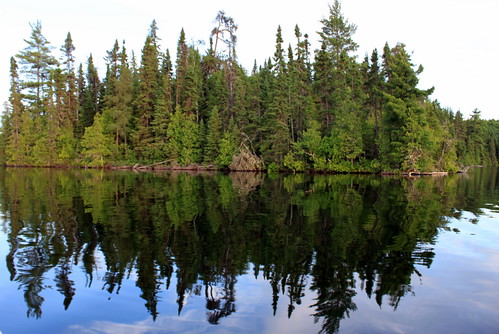
Northern Ontario Lake


The mail and supply run was one of my most favorite days ever.
Heading down the lake in the DOT canoe,
accompanied by the Father and the Brother in one canoe,
and two Indians and Brian Booth in the Bay canoe, thrilled me.  

I was living Canadian history,
canoeing with a French Canadian priest, a Hudson's Bay man,
and Ojibwa Indians.
I was a dauntless voyageur for real! 

Father Ouimet's canoe led the procession, 
followed by our canoe, and the Hudson's Bay canoe close behind.
3½ horsepower outboard motors powered the canoes,
with the men paddling wherever rocks made it tricky to use the motors. 

I sat close to the bow searching the sparkling water
for rocks lurking beneath the surface.
After a mile or so, with the sun beating on my back
and the lazy chirping of birds, I began to drowse.
Even living history can be soporific.

Occasionally loud booming startled me
and broke the droning of the outboard motors or the rhythmic paddling.
With each boom, a new crack opened or closed in the ice farther off shore,
and I realized how easily those jaws of ice could crush our fragile canoes.

Soon the peaceful canoe trip was over, and the men began
the tedious portage across a narrow part of the peninsula.
Roy was loaded with the paddles and gear,
while I was presented with the small outboard motor.
Dad and Duncan managed to shoulder the freighter canoe
and started up the tricky path.

The bush crowded in about us,
the birds quieted down,
and the hum of flies replaced their chirping.

In the middle of the trek toward the high point of the portage,
we came across a patch of slippery snow.  
Dad and Duncan slipped, and the canoe went down
as they floundered in the cold, wet, snow.
Fortunately, an Indian came to their rescue
and carried the canoe to the other side of the peninsula.

I sat down by Father Ouimet and began the long wait for the plane to arrive.
Each second oozed out ever so slowly.
The warm sun made me drowsy again,
and I stayed awake only by batting at pesky flies.

A particularly constant drone caught my ear,
and I hoped its owner was not thirsty.
The irritating drone increased in volume,
and I sat up in a snap, eyes searching.

That was no fly or mosquito.
It was a plane, the mail plane!

Far across the shimmering blue lake,
winging over the spruce-hemmed horizon,
I spotted a tiny silver plane.
It quickly grew larger and larger
as it ate up the distance between us.
Then it banked and glided to the surface of the lake,
a spray of water trailing from each pontoon.


A Pontoon Plane Landing


The men piled into the canoes and rushed out to meet the plane.
Everyone hurried because the breeze was shifting
and that meant the ice near Lansdowne House might shift as well.
The pilot was anxious to take-off in case
ice was driven into the area where he had landed.

It took a good forty-five minutes to off-load the mail and supplies.
As soon as one canoe was loaded, 
it motored for Lansdowne House at the tip of the peninsula, 
plowing through the water immersed almost to its gunwale.

Our canoe was the last to leave,
and the moment we were clear of the plane,
the pilot started the engine and taxied to take off.
Soon the plane disappeared over the horizon,
and we were alone in the silence of the wild.

As we traveled up the south side of the peninsula,
we could see that the ice was moving toward the shore.
We had to beat the ice.

It was tough going as our heavily-loaded canoe
wallowed through the water and the ice closed in.
Dad and Duncan fended off floating pans
and hacked at narrow passages with their paddles,
their faces glistening with sweat despite the chill of the nearby ice.

As we were forced closer to the shore, 
rocks in the shallowing water became an increasing danger.
The ice ground against the shore behind us 
as the wind drove it up on the land.
Roy and I could feel the rising tension in the adults.

Dad groused, "If only we could get rid of a couple hundred pounds,"
and Roy and I found ourselves unceremoniously dumped on the shore.

"Follow the shore up to the top of the peninsula.
You'll be fine," Dad yelled,
and off we took, hurrying through the bush.

It was quite a novel experience for us
to push through the scratchy thickets,
but it wasn't scary.
All we had to do was keep the lake on our right
and the bush on our left.

Soon we reached the first Ojibway houses
and followed a well-trodden path to the school,
past the nursing station, by the DOT complex,
and on to the Hudson's Bay dock.

We watched Dad and Duncan race for the shelter of the dock
as the ice closed up the water behind them.

Three hungry and weary voyageurs-for-a-day arrived home,
looking for a hot meal and a comfortable bed.
There were few times in my life
when food tasted better and bed feel softer.
It was the best of days.


Till next time ~
Fundy Blue

Beautiful Cove, Long Island,
Bay of Fundy, Nova Scotia


© M. Louise (MacBeath) Barbour/Fundy Blue
All Rights Reserved