This week I found some information about the lovely sand face I shared last week.

Sand Sculpture
Royal Hawaiian, Waikiki, Hawaii, USA
February 27, 2023
© M. Louise (MacBeath) Barbour/Fundy Blue
All Rights Reserved
The face was part of a gorgeous sand sculpture in the Royal Hawaiian on Waikiki.

The Royal Hawaiian asked Sandsational Sand Sculpting
to make a sand sculpture featuring the ulīʻulī,
the feathered gourd rattle that is used as an instrument in the Hawaiian hula.

Ulīʻulī (red and yellow) with ipu heke ʻole (hollowed gourd percussion instrument)
and pahu drum (upper left - Hawaiian Hula Drum)

Hula Dancers perform with the Ulīʻulī
Royal Hawaiian Center, Waikiki, Hawaii, USA
January 24, 2023
© M. Louise (MacBeath) Barbour/Fundy Blue
All Rights Reserved
The result is the most beautiful sand sculpture I've ever seen:

Here the Hula Dancers Hold the Ulīʻulī above Their Heads
Royal Hawaiian, Waikiki, Hawaii, USA
February 27, 2023
© M. Louise (MacBeath) Barbour/Fundy Blue
All Rights Reserved

A Closeup of the Hula Dancers
Royal Hawaiian, Waikiki, Hawaii, USA
February 27, 2023
© M. Louise (MacBeath) Barbour/Fundy Blue
All Rights Reserved
The ancient style ulīʻulī was made from the ipu gourd or coconut shells.
Three or four evenly-spaced holes were made around the gourd, about a quarter of the way down from the top.
A bigger hole in the apex of the gourd was used for cleaning out the gourd
and partially filling it with small shells, pebbles, or seeds.
Fiber from the pandanus leaf or ti plant was run through the holes,
tied, and wrapped in place to form a handle.
The "pouf" at the end of the handle was trimmed and decorated or left alone.

The Met: The Crosby Brown Collection of Musical Instruments, 1889
The seed of the ali`ipoe (canna lily) is preferred.
A wooden dowel is glued into the apex hole, a disk is attached to the dowel,
and feathers decorate it.
Hula dancers quickly rotate the ulīʻulī back and forth in their hands
or strike them against a hand, shoulder, or thigh.
The gourds are never hit together.
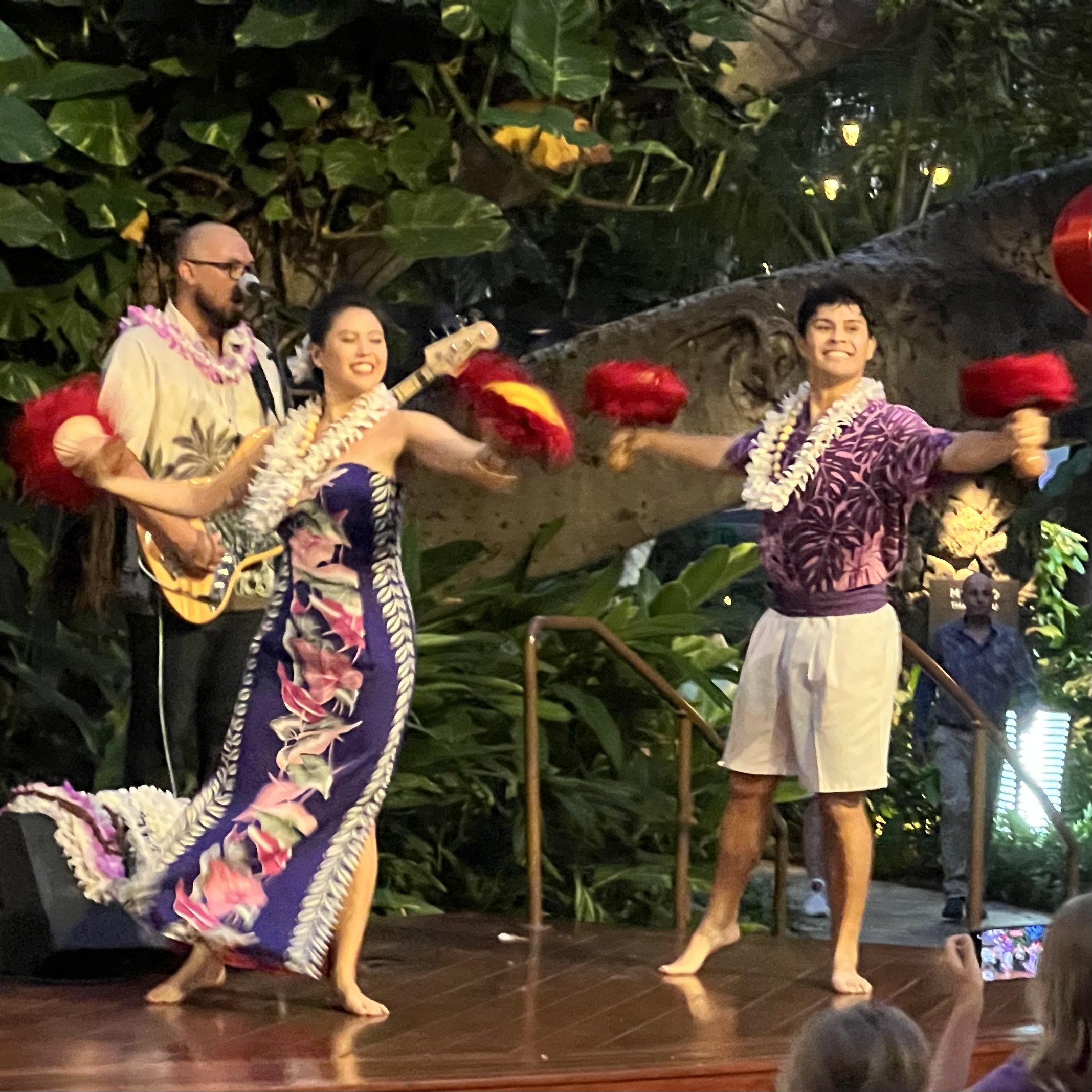
Hula Dancers perform with the Ulīʻulī
Royal Hawaiian Center, Waikiki, Hawaii, USA
January 24, 2023
© M. Louise (MacBeath) Barbour/Fundy Blue
All Rights Reserved

Hula Dancers perform with the Ulīʻulī
Royal Hawaiian Center, Waikiki, Hawaii, USA
January 24, 2023
© M. Louise (MacBeath) Barbour/Fundy Blue
All Rights Reserved
When I saw the ulīʻulī sculpture in the Royal Hawaiian,
I was fascinated by the beauty and the detail of the sculpture.
It was hard to believe that it was made of sand!

A Closeup of the Hula Dancers
Royal Hawaiian, Waikiki, Hawaii, USA
February 27, 2023
© M. Louise (MacBeath) Barbour/Fundy Blue
All Rights Reserved
Sandsational Sand Sculpting has been creating sand sculptures
around the world since 1996.
It's team of creative professionals have backgrounds in
industrial design engineering, fine art, performance art and marketing.
Jill Harris and 2010 World Champion Thomas Koet not only do commercial sand sculpting,
they are known and respected worldwide for the magnificent sculptures
they make in premier master sand sculpture competitions.


Many people are curious about how sand sculptures stick together
and last a long time even outside in the weather.
If you've ever built a sand castle at the beach,
you know that it collapses as soon as the water reaches it.
My brother and I had lots of fun building sand castles with deep moats when we were kids.
We took great delight in watching the water fill the moat,
then swallow our castle as the tide rose.
For answers to how to build sand sculptures that last, I went to the website
of the World Sand Sculpting Academy (WSSA) in The Hague.
When building a sand sculpture you can only use sand and fresh or sea water.
Beach sand typically doesn't work because the sand grains are rounded.
River sand is needed because the grains are angular
and the sand contains some silt and clay.
These river sand features allow the sand to stick together.
Sculptures are built in two stages: compacting and carving.
In the compacting stage, sand is placed into a wooden form and mixed with water.
The sand is compressed layer by layer, by hand or with machinery.
Once the top of the sculpture height is reached, the wooden forms are removed,
and the sculptor(s) can begin carving.

Ted Siebert, Lead Sculptor of The Sand Sculpture Company
Flickr ~ Abraham Puthoor ~ License
A number of factors go into how long a sand sculpture lasts:
sand quality, weather, location (outdoors or in), and climate.
Sculptures like the ulīʻulī inspired one inside the Royal Hawaiian can last for years,
as long as they are not touched.
There is a lot more information at the WSSA website.

A Closeup of the Hula Dancers
Royal Hawaiian, Waikiki, Hawaii, USA
February 27, 2023
© M. Louise (MacBeath) Barbour/Fundy Blue
All Rights Reserved
Here's a video I took at the Royal Hawaiian Center
of hula dancers performing with pu'ili bamboo sticks.
I only have still photos of the hula dancers using the ulīʻulī.

Hula Dancers perform with the Ulīʻulī
Royal Hawaiian Center, Waikiki, Hawaii, USA
January 24, 2023
© M. Louise (MacBeath) Barbour/Fundy Blue
All Rights Reserved
Thanks for asking me to find out more about the photo I shared last week.
I learned a lot, and you know I love to learn!

Till next time ~
Fundy Blue
My next post will be on
April 5, 2023 🤞
On the Bay of Fundy
© M. Louise (MacBeath) Barbour/Fundy Blue
All Rights Reserved
